Every week, you dutifully collect food scraps, fill your green bin, and roll it out to the curb. The truck comes, empties it, and drives away. But where does all that organic waste actually go? And what transforms your banana peels and coffee grounds into the rich, dark compost that gardeners love?
Understanding this journey isn't just interesting—it helps explain why certain practices matter more than others. When you know what happens behind the scenes, you'll understand why paper bags work better than plastic, why contamination is such a problem, and why your individual composting choices have real environmental impact.
Let's follow your organic waste from your kitchen through the entire composting process, uncovering the fascinating science and industrial operations that turn trash into treasure.
Collection Day: The First Step
Your composting journey begins when the collection truck arrives at your curb. Waste management companies operate specialized trucks that keep organic waste separate from trash and recycling throughout the entire collection route.
These trucks are specifically designed for organic waste collection. They compress the material to maximize capacity while minimizing odor release. The hydraulic systems pack hundreds of households' worth of food scraps and yard waste into a single truck, which then heads to a processing facility.
This is why contamination matters so much. When someone throws plastic bags, metal cans, or other non-organic materials into their green bin, those contaminants get mixed with everyone else's organic waste. The truck can't separate materials—it just compresses everything together. Contamination at this stage affects the entire truckload.
The collection trucks make multiple stops throughout their routes, gradually filling up before heading to the processing facility. Depending on the route, this might be a regional composting operation in the area.
Arrival at the Composting Facility
When collection trucks arrive at a composting facility, they first pass through a weigh station. Every load is weighed to track the volume of organic waste being processed. This data helps facilities plan operations and also provides metrics for regulatory compliance under California's SB 1383 requirements.
The trucks then dump their loads in designated receiving areas. If you could see this moment, you'd be amazed at the sheer volume. What seemed like a lot of waste from individual households becomes a mountain when combined with hundreds of other green bins.
At this stage, facility workers conduct a visual inspection of incoming loads. They're looking for obvious contamination—things that clearly don't belong. Large pieces of plastic, metal, glass, or other non-organic materials are removed before processing begins.
This is where bioplastic bags become a problem. They look like plastic to facility workers, so they're often removed along with other contamination, even though they're technically "compostable." Those bags you paid extra for? They might never make it past this first inspection.
Paper bags, on the other hand, are obviously organic. They're left in the pile because workers know they'll break down quickly and completely during the composting process. This is one of many reasons facilities prefer paper over bioplastic alternatives.
The Grinding Process
Once obvious contamination is removed, the real processing begins. The first major step is grinding or shredding the organic material into smaller, more uniform pieces.
Industrial grinders are massive machines with powerful blades and hammers that can process tons of material per hour. They take everything in the pile—food scraps, yard waste, paper bags, branches—and reduce it to pieces typically 1-3 inches in size.
Why grind? Smaller pieces have more surface area, which means more contact between organic matter and the microorganisms that break it down. A whole watermelon rind might take months to decompose naturally, but when ground into small chunks, it can break down in weeks.
The grinding process also mixes everything together, creating a more homogeneous material that composts more uniformly. Your coffee grounds mix with someone's yard clippings and another person's vegetable peels, all becoming part of the same batch.
During grinding, any remaining contamination that's hard or metallic tends to reveal itself. Metals make distinctive sounds when they hit the grinder blades. Glass shatters. These materials are captured by magnets or screening systems and removed before they can contaminate the finished compost.
This is another point where bioplastic bags cause significant problems. When bioplastic bags enter the grinding process, they create plastic-like fragments that become mixed throughout the organic material. According to composting facility operators, these fragments are difficult to remove and create contamination issues. The bags don't break down fast enough during the composting timeline, and facilities report operational challenges from materials that look like plastic but claim to be compostable. These plastic-like materials can clog and break composting facility machinery, forcing workers to manually remove contamination and halting operations to clear equipment—a costly and time-consuming process.
Creating the Compost Pile
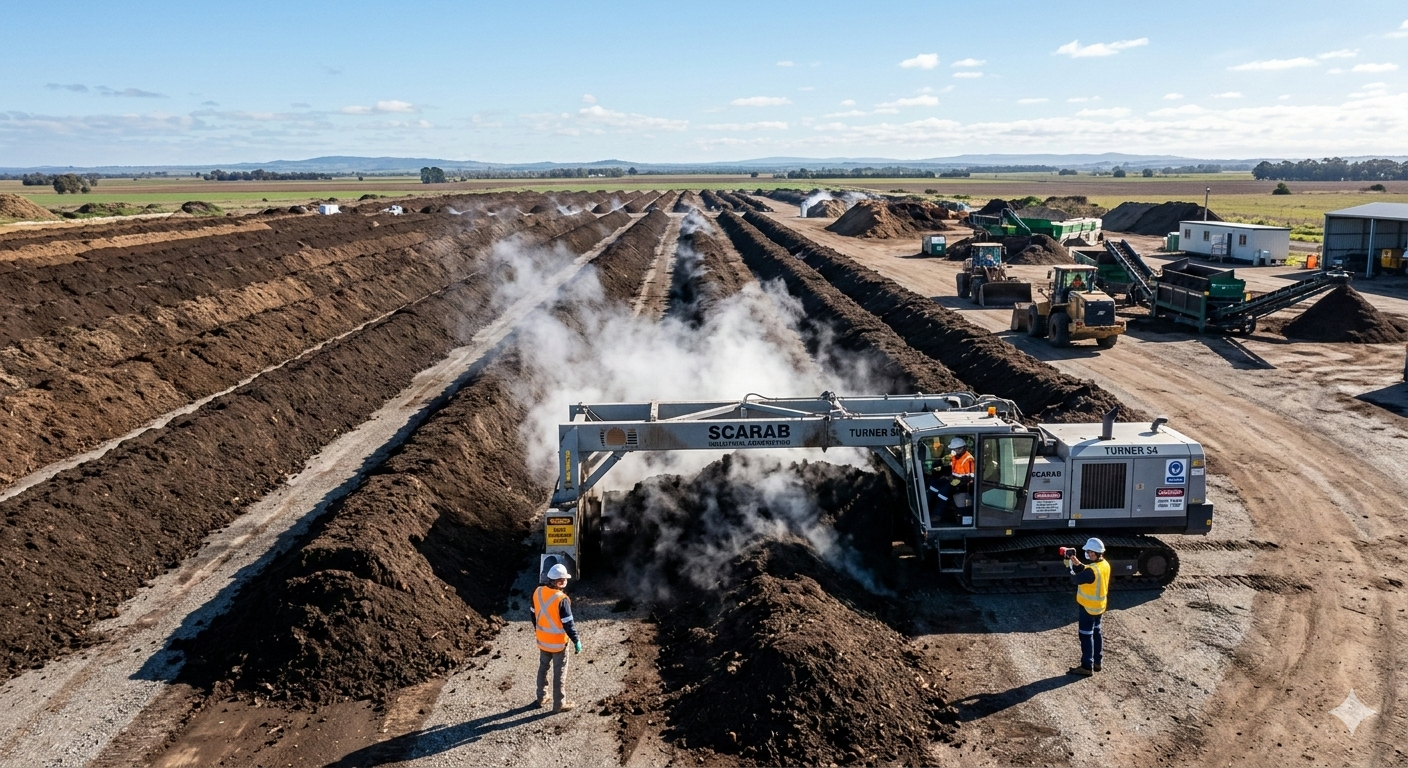
After grinding, the material is formed into long rows called windrows. These aren't just random piles—they're carefully engineered structures designed to optimize the composting process.
A typical windrow might be 10-12 feet wide, 4-6 feet tall, and hundreds of feet long. The exact dimensions vary based on the facility's equipment and the material being composted, but the goal is always the same: create conditions where aerobic microorganisms can thrive.
Facility operators monitor the composition of each windrow, aiming for the right balance of materials. Ideally, they want a carbon-to-nitrogen ratio around 30:1. Food scraps are nitrogen-rich (green materials), while yard waste like dried leaves and wood chips are carbon-rich (brown materials).
Getting this balance right is crucial for effective composting. Too much nitrogen and the pile becomes slimy and produces ammonia odors. Too much carbon and decomposition slows down. The mixture coming from residential green bins isn't always perfectly balanced, so facilities often add supplemental materials to adjust the ratio.
Some facilities also add a "starter" of mature compost to new windrows. This inoculates the pile with established populations of beneficial microorganisms, jumpstarting the decomposition process.
The Heat Is On: Active Composting
Once the windrow is formed, the real magic begins. Within hours, the pile starts heating up. Within days, internal temperatures can reach 131-170°F (55-77°C).
This heat isn't from external sources—it's generated by the microorganisms themselves. As billions of bacteria, fungi, and other decomposers break down organic matter, they release energy in the form of heat. A well-managed compost pile becomes a biological furnace.
These high temperatures serve multiple critical purposes. First, they accelerate decomposition dramatically. Processes that would take months or years at ambient temperatures happen in weeks at these elevated temperatures.
Second, the heat kills pathogens, weed seeds, and plant diseases. This is why you can safely put meat, dairy, and diseased plants in your green bin—the industrial composting process reaches temperatures high enough to destroy harmful organisms that would survive in a home compost pile.
Third, the heat is a sign that the process is working correctly. Facility operators monitor temperatures closely. If a windrow isn't heating up properly, it indicates a problem—maybe too much moisture, too little oxygen, or an imbalanced carbon-to-nitrogen ratio.
This is where the six-month timeline for bioplastic bags becomes an issue. The active hot composting phase typically lasts 6-8 weeks. After that, temperatures drop as the readily available organic matter has been consumed. Bioplastic bags that need 180 days to decompose are still mostly intact when this critical high-temperature phase ends.
Turning and Aeration
Composting is an aerobic process, meaning it requires oxygen. But as microorganisms consume oxygen, the inner parts of the windrow can become oxygen-depleted, creating anaerobic conditions that slow decomposition and create foul odors.
To prevent this, facilities regularly turn their windrows using specialized equipment. A windrow turner is like a giant rotating mixer that lifts material from the pile, tumbles it, and redeposits it. This brings material from the oxygen-depleted interior to the outside and vice versa.
The turning schedule varies by facility, but most turn their windrows every 3-7 days during the active composting phase. Each turning event introduces fresh oxygen, releases built-up moisture and carbon dioxide, and helps maintain the elevated temperatures needed for effective decomposition.
Turning also breaks up clumps and ensures even decomposition throughout the pile. Without turning, you'd end up with well-composted material on the outside and barely decomposed material in the center.
Modern facilities use sophisticated equipment for this process. Some have self-propelled turners that straddle the windrow and move along its length. Others use front-end loaders to rebuild windrows from scratch, carefully mixing and reforming the material.
During turning is when facility operators really see what's happening inside their compost. They can spot contamination that wasn't visible initially, monitor moisture levels, and assess how completely materials are breaking down. It's also when they'd notice if bioplastic bags or other slow-degrading materials are causing problems.
The Curing Phase
After 6-8 weeks of active composting, most of the easily degradable organic matter has broken down. The pile has shrunk considerably—typically by 40-60% of its original volume. The material looks darker and more soil-like. But it's not finished yet.
The compost now enters a curing or maturation phase. Temperatures gradually decrease to near ambient levels. The community of microorganisms changes from the heat-loving thermophiles that dominated the active phase to mesophiles that work at lower temperatures.
During curing, the remaining complex organic compounds continue to break down slowly. Fungi become more active, breaking down tougher materials like wood fibers. The compost develops a richer, earthier smell as volatile compounds dissipate and the material stabilizes.
This phase typically lasts another 4-6 weeks, bringing the total process time to about 10-14 weeks from start to finish. Industrial composting facilities are typically able to produce usable compost in a matter of weeks, compared to the months required for home composting.
Curing happens in separate areas from active composting. The piles don't need as much attention—maybe turning once a week or less. The focus is on letting time and biology complete the transformation from organic waste to finished compost.
Screening and Quality Control
After curing, the material looks and smells like compost, but it's not quite ready for sale. It still contains some pieces that haven't fully broken down, plus any contamination that made it through the process.
The next step is screening. Industrial screens are like giant sieves that separate finished compost from oversized pieces and contaminants. The screens might have openings of 1/4 inch, 1/2 inch, or larger depending on the intended use of the final product.
The material passes through the screens, with finished compost falling through the openings. Oversized pieces—wood chunks, incompletely composted materials, rocks, and contaminants—are caught on top of the screen.
This "overs" material (also called rejects) gets sorted. Organic materials that just need more time go back to new windrows for additional composting. True contaminants—plastics, glass, metals—are sent to the landfill.
This is the final checkpoint where bioplastic bag remnants often get removed. Even after 10-12 weeks, many bioplastic bags are still partially intact, looking enough like conventional plastic that they're screened out as contamination. They never make it to the finished product, which means they end up in a landfill despite being "compostable."
Quality control happens throughout the screening process. Facility staff monitor the finished compost for appearance, smell, moisture content, and contamination levels. Many facilities also conduct laboratory testing for pH, nutrient content, and pathogen levels to ensure their compost meets regulatory standards and customer expectations.
Where the Compost Goes
Once screened and tested, the finished compost has several possible destinations. Much of it is sold to agricultural operations, which use it to improve soil health and fertility. Compost adds organic matter to soil, improves water retention, provides nutrients, and supports beneficial soil microorganisms.
Local farms throughout San Diego County and California purchase compost from regional facilities, incorporating it into fields growing everything from avocados to strawberries to row crops. The nutrients from your kitchen scraps quite literally feed local agriculture.
Some compost goes to landscaping companies and municipal parks departments. The dark, rich material is ideal for planting beds, erosion control, and general landscape improvement. When you see beautiful landscaping around public buildings or in neighborhood parks, there's a good chance it was enhanced with compost made from local organic waste.
Garden centers and nurseries also purchase compost, either in bulk or bagged for retail sale. That bag of compost you buy at the hardware store might contain nutrients from your own food scraps, completing a remarkably local cycle.
Some facilities offer free or discounted compost to residents, recognizing that people who participate in organic waste collection programs deserve access to the finished product. Check with your local facility to see if they offer giveaway days or discounted bulk compost.
The Environmental Impact
This entire process—from your kitchen to finished compost—has profound environmental benefits that extend far beyond just reducing landfill waste.
When organic waste decomposes in a landfill, it does so anaerobically (without oxygen) because it's buried under layers of trash. This anaerobic decomposition produces methane, a greenhouse gas 84 times more potent than carbon dioxide over a 20-year period. A landfill full of organic waste is essentially a methane factory.
In contrast, the aerobic composting process produces minimal methane. The carbon in organic waste is released primarily as carbon dioxide (which is much less potent) or sequestered in the stable organic matter of finished compost. The climate impact difference is dramatic.
San Diego County diverts over 300,000 tons of organic waste annually through composting programs. If this material went to landfills instead, it would produce roughly the same greenhouse gas emissions as 50,000 cars driven for a year. By composting, we're preventing those emissions entirely.
The finished compost also provides environmental benefits when applied to soil. It improves soil structure, reducing erosion and runoff. It increases water retention, reducing irrigation needs. It supports soil biology, reducing the need for synthetic fertilizers and pesticides. These benefits multiply across thousands of acres of agricultural and landscaped land throughout the region.
Why Your Choices Matter
Understanding this process explains why seemingly small choices in your kitchen have outsized impacts.
Using paper bags instead of plastic makes every step easier. They don't get screened out at receiving. They don't create fragments during grinding. They break down completely during active composting. They don't contaminate the finished product. They simply work with the process instead of against it.
Avoiding contamination matters because it doesn't just affect your bin—it affects entire truckloads and windrows. A single metal can or plastic bag in your green bin might seem trivial, but multiplied across hundreds of households, it creates serious challenges for facilities trying to produce clean, marketable compost.
Composting consistently matters because the system only works when participation is widespread. One household composting makes a minimal difference. An entire neighborhood composting creates enough volume to justify collection routes and facility operations. A whole city composting transforms waste management and creates real environmental benefits.
The Future of Composting
Composting technology continues to evolve. Some facilities are experimenting with enclosed vessel systems that can control temperature, moisture, and oxygen even more precisely, potentially shortening composting times.
Others are exploring anaerobic digestion systems that capture methane from organic waste and use it for energy production, then compost the remaining digestate. These systems generate renewable energy while still producing finished compost.
Research is ongoing into compost uses beyond agriculture. Some studies suggest compost could help restore degraded soils, support ecosystem recovery, and even sequester carbon to help address climate change. The humble banana peel you tossed in your compost this morning might someday contribute to environmental restoration projects.
As composting infrastructure expands and improves, the environmental benefits will only grow. But the fundamental process—microorganisms breaking down organic matter into stable humus—remains the same biological cycle that's been occurring naturally for millions of years. We've just learned to harness it at industrial scale.
Your Role in the Cycle
Every time you scrape food scraps into your compost container, you're initiating this remarkable journey. Those scraps will be collected, ground, heated to temperatures that kill pathogens, turned regularly to ensure even decomposition, cured to stability, screened to remove contaminants, and ultimately returned to soil to nourish new plant growth.
It's a beautiful cycle that mimics nature's own decomposition processes, accelerated and optimized through human ingenuity. And it all starts with your daily choice to separate organic waste from trash.
The next time you empty your green bin, you'll know where it's going and what's happening to it. You'll understand why facilities care so much about contamination, why certain materials work better than others, and why your participation matters.
From kitchen to compost to soil to food, the cycle continues. And you're an essential part of making it work.
Keep your organic waste clean and contamination-free with EcoToss bags. Made from 100% paper that breaks down completely in composting facilities, they work perfectly with the composting process from collection through finished compost. No plastic remnants, no screening issues—just pure organic matter returning to the earth as nature intended.